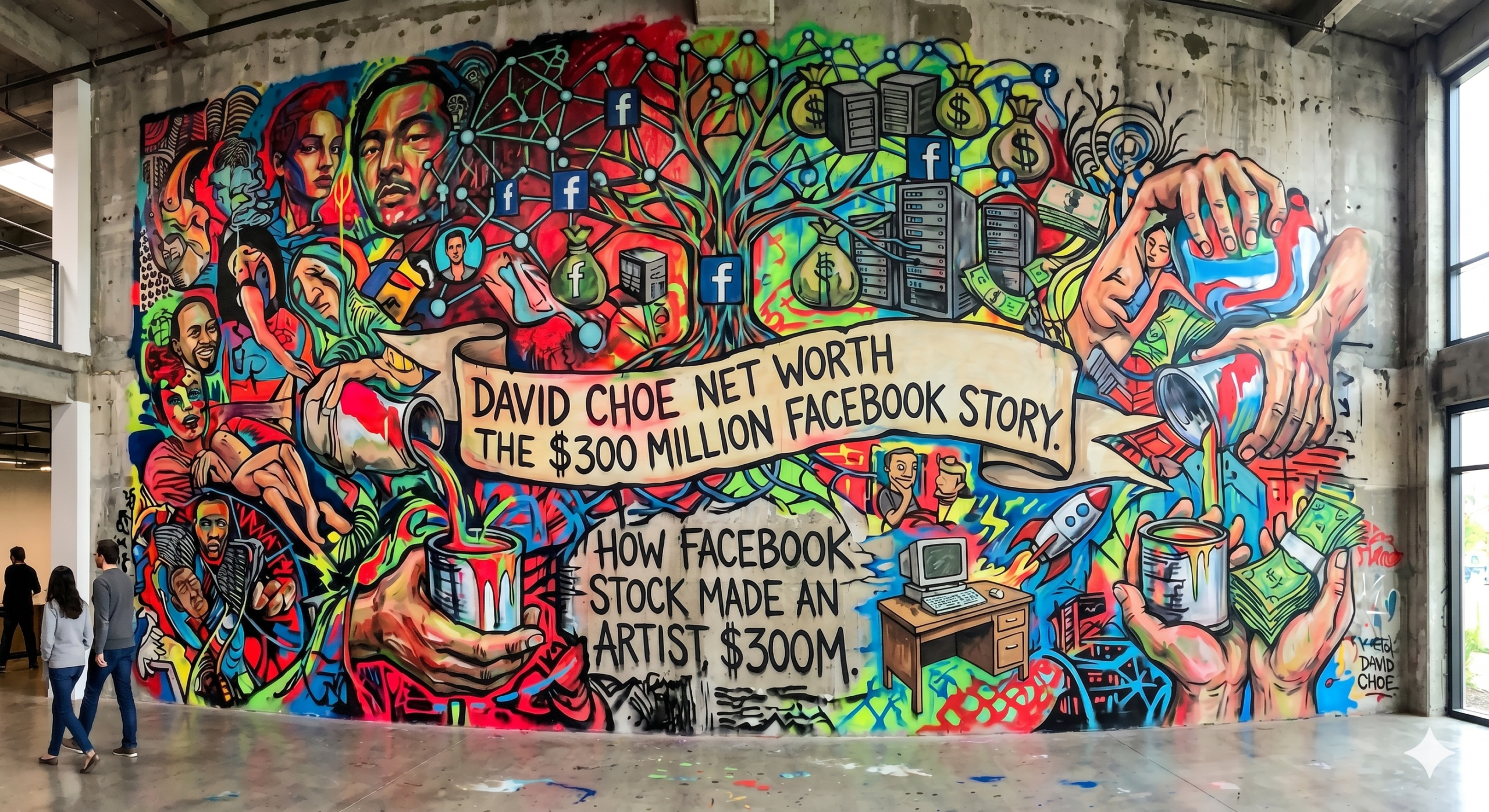
David Choe Net Worth: How Facebook Stock Made an Artist $300M
David Choe has an estimated net worth between $200 million and $300 million as of 2026. He accumulated the majority of his wealth through an early equity agreement with Facebook rather than traditional art sales. In 2005, he agreed to paint murals at the first Facebook headquarters in Palo Alto. The founders offered him a choice between a $60,000 cash payment or company stock representing about 0.25 percent of the business. He chose equity. When the social media company went public in 2012, those shares reached a value exceeding $200 million.
As a platform that tracks wealth accumulation and analyzes alternative compensation models, Net Worth Update presents the story of David Choe as a clear example of how accepting equity in a rapidly growing startup can produce extreme financial outcomes. This analysis examines the mechanics of his wealth generation, the risks involved in stock-based compensation, and the ways he continues to generate income today.
The Foundation of Early Equity Decisions
Before the Facebook deal, Choe built a reputation in the Los Angeles underground art scene. He published a graphic novel titled “Slow Jams” in the late 1990s, which won a grant and gained a cult following. His energetic style caught the attention of Sean Parker, who co-founded Napster and later became the president of Facebook.
When Facebook moved into its first official Palo Alto office in 2005, Parker wanted an aesthetic that reflected rebellion and high energy. He approached Choe for the mural project. Although Choe publicly stated he thought the social media business model seemed pointless at the time, he still accepted the stock option over the $60,000 cash fee. This represented a fractional percentage of the entire company.
This decision represents a high-risk gamble that paid off during the 2012 initial public offering. According to historical market data from Yahoo Finance, Facebook priced its initial public offering at $38 per share, establishing a corporate valuation over $100 billion. This event instantly turned his illiquid private shares into highly valuable, tradable assets.

By holding onto early-stage equity until a liquidity event, individuals can bypass the gradual wealth accumulation typical of salaried positions. A report published by Business Insider confirms that his specific share allocation was valued at roughly $200 million when the market opened for trading.
Bonus Tip: When a company offers equity in place of cash, evaluate the total addressable market and the track record of the founding team before making a final decision.
Net Worth Trajectory Through 2026
The valuation of David Choe has stabilized as tech markets matured. While his initial tech wealth was tied directly to Facebook stock, he spent the subsequent years diversifying his portfolio. By 2026, financial estimates suggest his total assets remain strong. This stability comes from real estate investments, continued art sales, and modern entertainment projects.
The table below outlines the estimated progression of his financial assets from the initial public offering through 2026. This data combines historical stock market pricing and recent art market valuations.
| Year | Estimated Net Worth | Primary Financial Driver |
|---|---|---|
| 2012 | $200,000,000 | Facebook Initial Public Offering |
| 2018 | $250,000,000 | Stock Growth and Media Contracts |
| 2023 | $300,000,000 | Art Valuation and Entertainment Projects |
| 2026 | $200,000,000 to $300,000,000 | Portfolio Diversification and Real Estate |
Recent reports, including estimates from Impact Wealth Magazine and historical tracking from Celebrity Net Worth, highlight the ongoing fluctuation of his fortune. This variance reflects the nature of owning highly variable assets like contemporary art and technology equities. Holding concentrated positions in individual tech stocks often leads to dramatic swings in personal net worth. By converting early stock gains into stable assets like index funds and property, wealthy individuals protect their baseline capital.
Art Sales and Entertainment Revenue
While the tech stock windfall secured his financial independence, Choe continues to produce substantial income through his primary profession. He is a highly sought-after artist, graphic novelist, and entertainer. His unique aesthetic, which he calls “dirty style,” combines frantic brushwork with emotional imagery. His original paintings command premium prices from private collectors and galleries around the world.
Beyond his canvas work, he expanded his income streams into media and entertainment. He has hosted travel and adventure series for Vice Media, exploring global subcultures, and secured a supporting acting role in the successful 2023 Netflix series “Beef.” These entertainment contracts provide steady cash flow and keep his public profile active. Maintaining a high public profile directly supports the financial valuation of his physical artwork.
Comparing Cash Versus Equity Compensation
To understand the magnitude of his 2005 decision, it helps to look at the alternative scenario. If he had taken the initial $60,000 cash payment and invested it in traditional market vehicles, his return would look entirely different. The data below assumes an average annual return of eight percent for the stock market over a seven-year period.
| Compensation Choice | Initial Value (2005) | Investment Vehicle | Estimated Value (2012 IPO) |
|---|---|---|---|
| Option A: Cash | $60,000 | S&P 500 Index Fund | ~$102,800 |
| Option B: Equity | $60,000 (Equivalent) | Facebook Private Stock | ~$200,000,000 |
This table illustrates the aggressive growth potential of private equity compared to standard market returns. It also highlights the extreme rarity of such an outcome. Most startup equity goes to zero, making his outcome a massive statistical anomaly.
Bonus Tip: Never hold your entire net worth in a single company stock. Sell portions of your concentrated positions periodically to fund a diversified portfolio of real estate, index funds, and standard bonds.
Things to Consider Before Making a Decision
Accepting equity instead of cash presents massive financial risks. The modern compensation environment often includes restricted stock units or standard stock options. Before making a similar compensation decision, evaluate these pre-decision factors carefully.
- Risk Tolerance: Startup companies fail at a high rate. You must be prepared to lose the entire value of the proposed compensation if the business declares bankruptcy.
- Immediate Cash Needs: You cannot pay daily living expenses with illiquid private shares. Ensure you have secondary income sources to cover your baseline financial obligations such as rent, food, and transportation.
- Vesting Schedules: Understand the timeline. Most companies require you to hold the stock or work at the company for several years before you actually own the shares.
- Tax Implications: Receiving equity can trigger immediate or future tax liabilities depending on how the contract is structured. You might owe taxes on stock you cannot even sell yet.
- Dilution Potential: As companies raise more funding rounds from venture capitalists, your initial percentage of ownership will decrease.
Bonus Tip: Always consult a certified public accountant when signing an equity compensation agreement to prevent unexpected tax bills at the end of the year.
Frequently Asked Questions
Did David Choe sell all of his Facebook stock?
Public records do not show exactly how many shares he sold or retained after the initial public offering. Financial analysts assume he sold a significant portion to fund his lifestyle and diversify his investments, while likely holding some shares for long-term market growth.
How much was David Choe offered in cash?
He received an offer of $60,000 in cash to paint the murals inside the original Palo Alto office. He declined the cash in favor of company equity.
What kind of art does David Choe make?
He creates street art, murals, and gallery paintings. He describes his chaotic and energetic approach as “dirty style” painting. He also creates graphic novels, digital illustrations, and mixed media projects.
Does he still make money from his art?
Yes. His status as a wealthy tech investor actually increased the public profile of his artwork. Private collectors purchase his physical paintings, and he earns acting and production fees from his entertainment projects.
What was the Facebook IPO price?
The company priced its initial public offering at $38 per share in May 2012. This pricing valued the entire business at over $100 billion.
Evaluating High-Net-Worth Strategies
The financial trajectory of this artist demonstrates the massive upside of private equity compensation. While his case represents an extreme outlier, it provides a clear lesson on the mechanics of startup valuation and wealth building. He used his creative skills to secure a stake in a rapidly scaling technology platform. His ongoing financial independence relies on a combination of that initial windfall and his continuous output in the art and entertainment sectors. Readers facing equity compensation offers should evaluate their specific situation, immediate cash needs, and long-term financial goals before declining guaranteed cash payments.
You Can Also Look For:
Don King Net Worth
Ryan Garcia Net Worth
Byron Allen Net Worth
Rick Rubin Net Worth
David Dobrik Net Worth
Tommy Lee Net Worth